Postpartum Workout Plan: A Hormone-Timeline Guide to Getting Back to Exercise

Your body isn't following a generic 6-week countdown. It's following a hormone timeline — and that's exactly what most postpartum workout plans ignore.
Her Fitness AI is a cycle- and hormone-aware fitness coaching app that pairs you with Mira, your AI coach, to adjust your workouts to where your body actually is in its hormonal recovery — not to a fixed week-by-week calendar everyone gets regardless of delivery type, feeding choices, or how they're sleeping.
Search "postpartum workout plan" and you'll find dozens of near-identical 4, 6, or 12-week programs. They're not wrong, exactly — but they're built around calendar weeks since delivery, when the thing actually driving your energy, joint stability, and recovery pace is hormonal, not calendar-based. Two people at "6 weeks postpartum" can be in completely different physical states depending on delivery type, breastfeeding status, and sleep.
Why hormones matter more than the calendar
Right after birth, estrogen and progesterone — which climbed steadily for nine months — drop sharply.
Layered on top of that:
- Prolactin and oxytocin rise to support milk production and let-down if you're breastfeeding, and stay elevated for as long as nursing continues — regardless of your activity level.
- Relaxin, the hormone that loosened your joints and ligaments to prepare for delivery, can linger in your system well past the standard 6-week "cleared for exercise" mark, leaving joints less stable for higher-impact movement.
- Cortisol often stays elevated for months, driven largely by sleep disruption rather than exercise itself — which is a big part of why you can feel wiped out even on light-activity days.
None of this means you should avoid exercise. It means the pace and intensity should track your actual hormonal recovery, not a countdown.
Our take: most postpartum programs treat "6 weeks postpartum" as a single starting line, when it's really a range of very different hormonal states depending on delivery type and feeding choices. We won't hand you a generic countdown just because it's simpler to write. What actually helps is progressing off your own hormonal signals — energy, joint stability, sleep — and that's the model Mira is built around.
A hormone-aware progression
This is a general framework — always defer to your own OB, midwife, or surgeon's clearance over any timeline in this article.
Weeks 0-2 (acute hormonal shift): Estrogen and progesterone have just crashed. Focus on gentle walking and breathwork only. This isn't the time to chase a workout streak — it's the time to let the biggest hormonal drop of your life settle.
Weeks 2-6 (early stabilization): If cleared for light activity, gentle core and pelvic floor work (breathing, pelvic tilts) can begin. Relaxin is still active, so avoid high-impact or heavily loaded movement.
Weeks 6-12 (relaxin still present): Around the standard 6-week clearance, many programs jump straight to running or full strength training. Because relaxin can remain elevated past this point, this is a reasonable window to build back strength training with control before adding real impact work like running.
3-6 months (breastfeeding-adjusted or hormone rebound): If you're not breastfeeding, estrogen and progesterone are generally trending back toward baseline by now. If you are breastfeeding, prolactin staying elevated is normal and not something to "push through" — energy dips here are physiological, not a discipline problem.

Put together, the pattern is simple even if the science sounds complicated: your body isn't behind schedule at "6 weeks" just because a generic plan says you should be back to full intensity. Estrogen, prolactin, relaxin, and cortisol are all moving on their own timelines, and any one of them running slower than average is a completely normal reason to still feel wiped out, stiff, or low on motivation.
:::
C-section recovery moves at its own pace
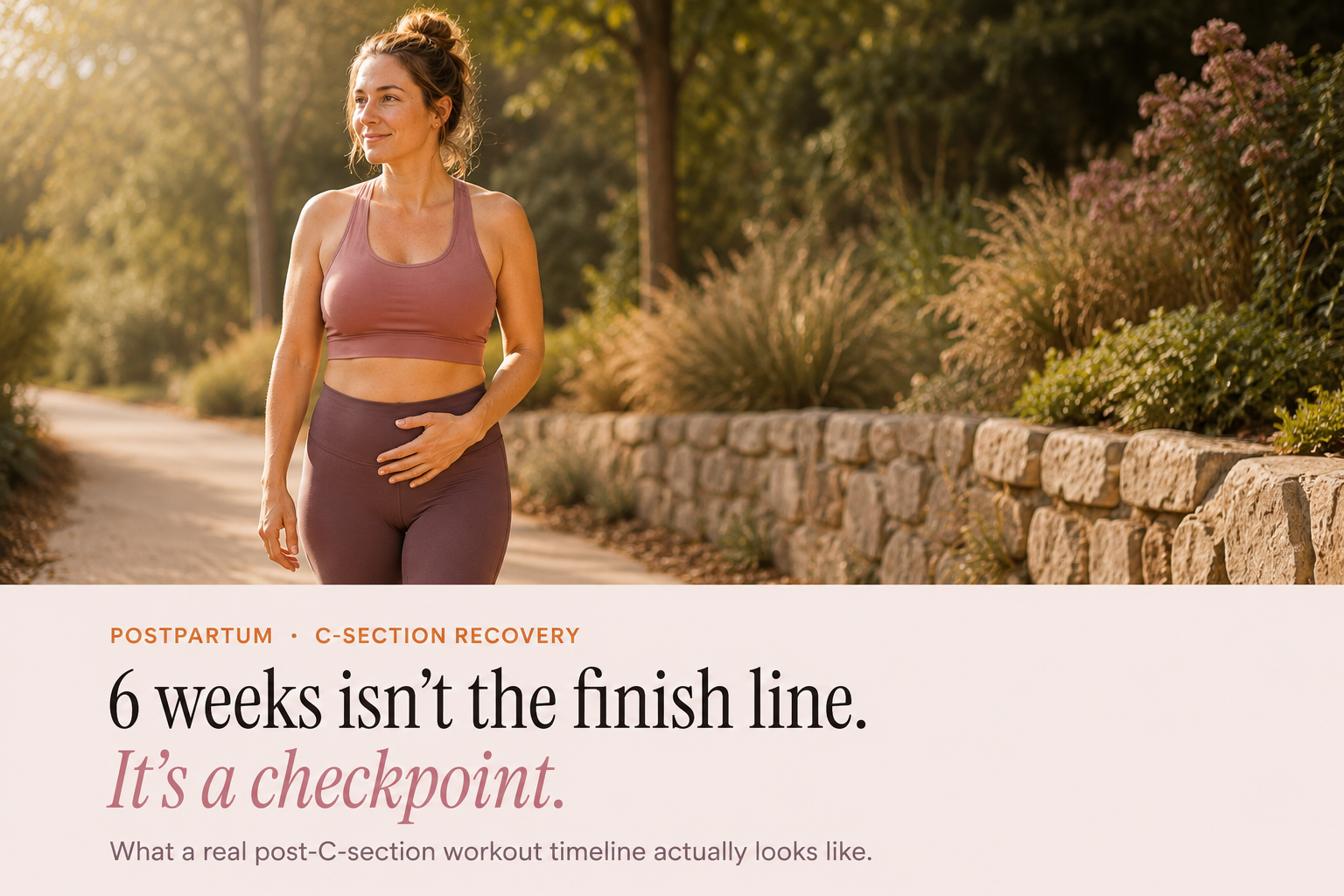
Everything above assumes a vaginal delivery. A C-section is abdominal surgery layered on top of the same hormonal shifts — so the return-to-exercise timeline generally runs slower, with most guidance holding off on core work and higher-intensity training until at least 12 weeks and full surgical clearance. We cover this in more depth in an upcoming post on C-section-specific recovery.
What this looks like with Mira
Mira asks about your delivery type, feeding status, and how you're sleeping — then adjusts workout intensity and volume week to week based on those inputs, rather than assuming everyone at "week 8" is in the same place.
The bottom line
A postpartum workout plan built purely around weeks since delivery will always be a rough approximation, because the thing actually driving your recovery pace — your hormones — doesn't run on a fixed clock. Estrogen and progesterone crash fast, relaxin lingers, prolactin stays elevated if you're breastfeeding, and cortisol tracks your sleep more than your workout log. Training with that timeline in mind, instead of against it, is the difference between a plan that fits your body and one you're just trying to survive.

Frequently Asked Questions
When can I start working out postpartum?
Most people can begin gentle movement like walking within days of an uncomplicated vaginal birth, with clearance for more structured exercise typically given around 6 weeks. C-section recovery generally calls for longer — often 8-12 weeks. Your own doctor's clearance always overrides a generic timeline.
Does exercise affect breast milk supply?
Moderate exercise doesn't reduce milk supply or quality. Feeding or pumping before a workout can ease breast discomfort from engorgement, since prolactin and oxytocin stay elevated throughout breastfeeding regardless of activity level.
Why am I so tired even after light exercise postpartum?
It's rarely just the workout. Cortisol often stays elevated in early postpartum months due to sleep disruption, on top of the estrogen and progesterone drop right after birth. That's a physiological reason for fatigue, not a sign you're out of shape.
Is running safe right after having a baby?
Most guidance suggests waiting until at least 3 months (later after a C-section), since lingering relaxin can leave joints less stable for higher-impact movement like running well past the standard 6-week mark.
What's different about a C-section recovery timeline?
Because it's abdominal surgery, recovery is generally slower than after a vaginal birth — light walking early on, with core work and higher-intensity training usually held off until at least 12 weeks and full surgical clearance.
Sources
- Samphire Neuroscience. (2026). Postpartum Hormones: What to Expect. samphireneuro.com/postpartum-hormonal-changes-what-to-expect
- Therabody. (2026). 6 Ways Exercise Supports Postpartum Recovery. therabody.com/6-ways-exercise-supports-postpartum-recovery
- GoodRx Health. (2024). 11 Tips to Create a Postpartum Workout Plan Fit for You, citing American College of Obstetricians and Gynecologists exercise-after-pregnancy guidance. goodrx.com/postpartum-workout-plan
- Matrescence Therapy. (2025). Postpartum Hormone Timeline: What to Expect Month by Month. matrescence-therapy.com/postpartum-hormone-timeline
Written by Team Her Fitness AI. This content is for informational purposes and isn’t a substitute for medical advice.
Related Reads
More from the Her Fitness AI blog.