Cycle Syncing Workouts: The Complete Guide

Cycle syncing workouts means matching your training intensity to the four phases of your menstrual cycle — menstrual, follicular, ovulation, and luteal — instead of running the same routine every week. The goal is to work with your natural shifts in energy, strength, and recovery, rather than push through them regardless of how you feel.
Her Fitness AI is an AI coaching app that adjusts workouts and nutrition to your menstrual cycle.
If you've ever crushed a workout one week and barely made it through a warm-up the next, this isn't a motivation problem — it's hormones. Estrogen and progesterone rise and fall on a predictable pattern across roughly four weeks, and that pattern shows up in your energy, your strength, your appetite, and how well you recover. Cycle syncing simply means building your training around that pattern instead of ignoring it.
What Is Cycle Syncing, Exactly?
Cycle syncing is the practice of adjusting your workouts (and often your nutrition and daily habits) to match the hormonal phase you're currently in. Rather than a single fixed weekly split, your training plan flexes with a roughly month-long rhythm — higher-intensity days when estrogen is rising and you're primed for output, gentler days when hormones dip and recovery takes priority.
It isn't about doing less. It's about doing the right thing at the right time, so consistency doesn't depend on willpower alone.
What Are the Four Cycle Phases — and What Do They Mean for Training?
Menstrual phase (roughly days 1–5): Estrogen and progesterone are at their lowest. Energy and strength typically dip here too, which is why gentle movement — walking, restorative yoga, mobility work — tends to feel better than pushing for a personal best.
Follicular phase (roughly days 6–13): Estrogen starts climbing as an egg matures, and most people feel a real uptick in energy, mood, and motivation. This is a strong window for building intensity — heavier lifts, longer runs, new skills.
Ovulation (roughly days 14–16): Estrogen peaks just before ovulation, often bringing peak strength and confidence. Many women find this their best window for personal-best attempts or high-intensity intervals.
Luteal phase (roughly days 17–28): Progesterone rises while estrogen drops, which can bring lower energy, more fatigue, and increased body temperature. Training usually feels better here if you shift toward moderate intensity, more recovery time, and paying closer attention to hydration and fueling.
These day ranges are estimates based on an average 28-day cycle — yours may run shorter, longer, or less predictably, and that's exactly what a cycle-aware tool like Her Fitness AI is built to track for you rather than making you do the math.
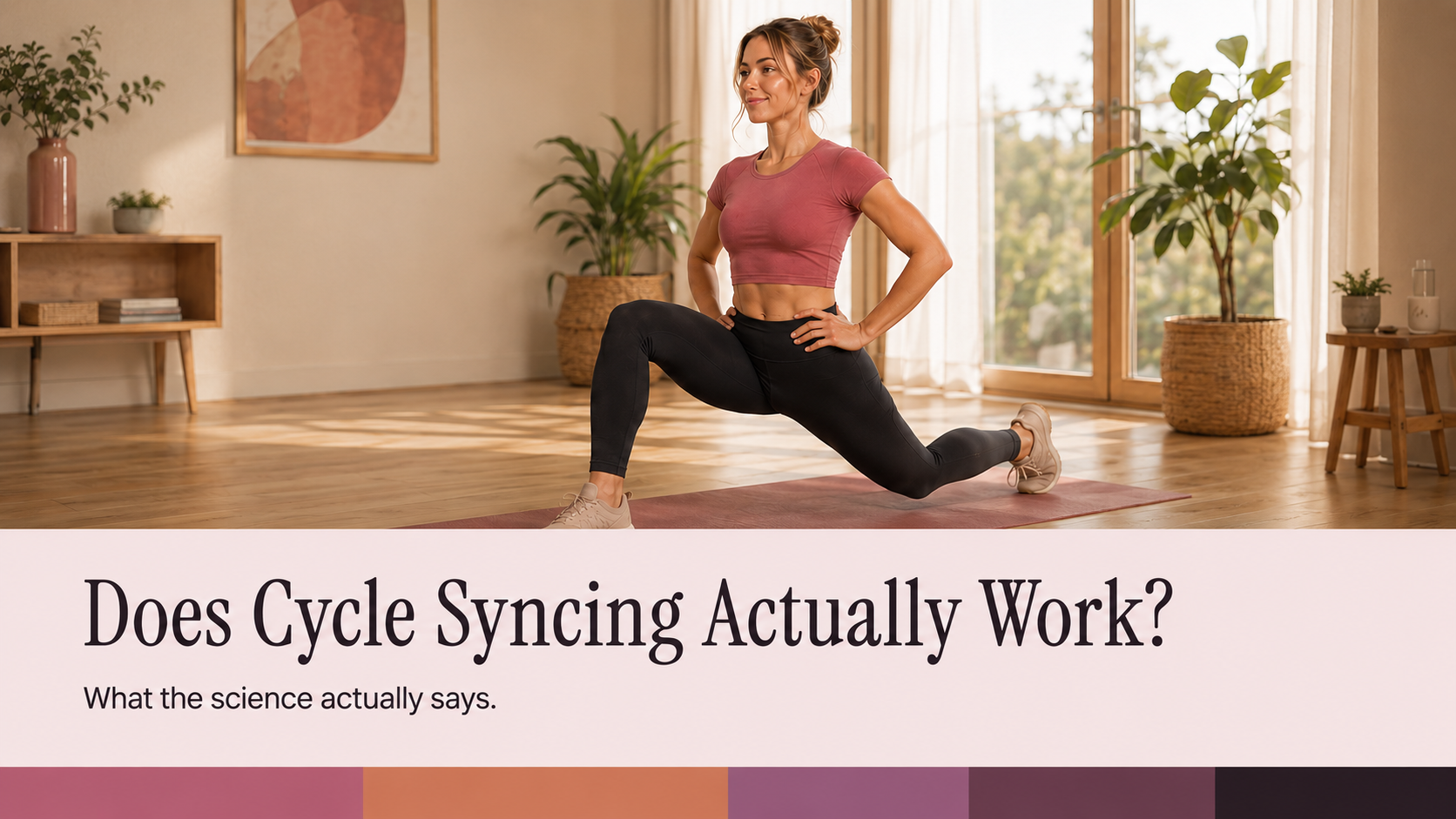
Does Cycle Syncing Actually Work?
Here's the honest, non-hype answer: the research is genuinely mixed. Some reviews find measurable strength differences tied to cycle phase (like the meta-analysis above); others — particularly reviews focused on elite athletes — find the evidence too inconsistent to make blanket claims. What most experts agree on is narrower and more useful: your subjective energy, motivation, and recovery do fluctuate with your cycle for most women, even in studies where objective performance numbers don't move much. Training with that in mind — rather than against it — tends to support consistency, which is often the bigger lever than any single workout's intensity.
What Workouts Should You Do in Each Phase?
- Menstrual: Walking, restorative yoga, mobility, light Pilates, or a full rest day if you need it.
- Follicular: Strength training with progressive overload, running intervals, new class formats — your body adapts well to new stimulus here.
- Ovulation: Your highest-intensity window — HIIT, heavy compound lifts, event PRs if you have them planned.
- Luteal: Moderate steady-state cardio, strength training at slightly lighter loads with higher reps, swimming, or hiking. Save the max-effort days for after your next period.
None of this is a rigid rulebook. It's a starting framework you adjust based on how you actually feel that day — which is also exactly what cycle-aware coaching is meant to do for you automatically.

How Do You Start Cycle Syncing Your Workouts?
- Track your cycle for one to two months before changing anything — note your actual energy and soreness, not just calendar days.
- Loosely map your phases using the ranges above, adjusted to your own average cycle length.
- Shift intensity, not identity — you're still doing strength work, cardio, and mobility every phase; only the volume and intensity shift.
- Expect it to take a few cycles before you notice a clear pattern. Bodies aren't identical month to month.
- Let the app do the math — Her Fitness AI tracks your phase automatically and adjusts your daily workout suggestion, so you're not guessing which phase you're in or manually rebuilding your plan every week.

Frequently Asked Questions
What are the four phases of the menstrual cycle for cycle syncing?
Menstrual, follicular, ovulation, and luteal. Each phase brings a different hormonal profile — estrogen and progesterone rise and fall in a predictable order — which is why energy and recovery needs shift across the month rather than staying constant.
Can cycle syncing help with PMS symptoms?
Some practitioners and coaches report cycle syncing easing PMS-related fatigue and mood dips by matching training intensity to how the body feels in the luteal phase, though it isn't a treatment and results vary person to person.
How long does it take to see results from cycle syncing?
Most people need a few cycles — commonly a few months — before a clear pattern of energy, mood, and performance emerges, since the first cycle or two is really just data-gathering.
Can cycle syncing support weight loss?
It can indirectly help by aligning workout intensity and appetite management with hormonal shifts, which may support more consistent training and eating habits — but it isn't a guaranteed weight-loss method on its own.
Do I need a period-tracking app to cycle sync my workouts?
Not strictly — you can track manually with a calendar and notes — but an app removes the guesswork of knowing which phase you're in on any given day, which is where a lot of people give up on cycle syncing manually.
Sources
- Niering, M. et al. (2024). The Influence of Menstrual Cycle Phases on Maximal Strength Performance in Healthy Female Adults: A Systematic Review with Meta-Analysis. Sports, 12(1), 31. pmc.ncbi.nlm.nih.gov/articles/PMC10818650
- Meignié, A. et al. (2021). The Effects of Menstrual Cycle Phase on Elite Athlete Performance: A Critical and Systematic Review. Frontiers in Physiology, 12:654585. pmc.ncbi.nlm.nih.gov/articles/PMC8170151
Written by Team Her Fitness AI. This content is for informational purposes and isn’t a substitute for medical advice.
Related Reads
More from the Her Fitness AI blog.